We can do better
By David Fuks
“Two judges from the United States Court of Appeals for the Fifth Circuit issued a ruling that, if allowed to stand, could result in the indefinite detention of millions of immigrants in inhumane, overcrowded facilities scattered across the United States.”
– David French, NY Times, 2/12/26
Forty years ago, when my oldest son was born, our family flew to Florida to introduce our new baby to my parents. Our baby, Benjamin, was a beautiful little boy. This was a sweet moment for our family. But there was also a stunning moment of darkness and grief.
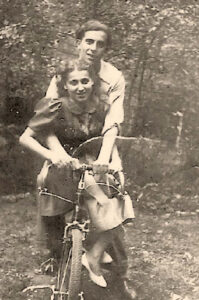
My father, Henry, who was then 70 years old, shared a picture with us. It had been taken two years prior to World War 2. Henry was on a bicycle and a young woman was sitting on the bike. It was a sweet moment in a park. I had never seen my father looking so relaxed.
I didn’t recognize the young woman in the photo. Her name was Alta Rosensweig. She was my father’s first wife. They had a child. Her name was Bluma. It means flower. I was 35 and had never known about Alta and her baby. Henry shared that a friend who witnessed their deaths in Auschwitz shared the story of their murders. An SS guard had selected the baby to die and wanted Alta to live as a slave. Alta objected and carried Bluma into the gas chamber where they died together.
The war had ended 40 years before he showed me the photo. I believe that my father was triggered to share this relationship and trauma because I had what he had lost…a wife and child. He had often shared comments about his suffering in Buchenwald where he spent five years as a slave.
Henry taught his children to be proud to be descendants of slaves. We were expected to contribute to the well-being of the community. We were to recognize that we were no better than anyone else. My father’s tears at this moment of revelation were stunning. The trauma, grief and anger were testimony of the pain that was still alive in his heart.
Henry met my mother, Rachel after the war. They spent four years in a Displaced Person’s Camp in Landsberg, Germany. They were allowed to enter the United States in 1949. I was born in 1950.
My sisters and I were fortunate to grow up in an era of hope and strength in the USA. Despite the political challenges of that era, we witnessed a country that was progressing and moving towards justice. While our parents struggled with PTSD and OCD, they also provided us with safety, education and the capacity to love. We became resilient as we faced the vicarious traumatization that our parents could not help sharing.
But now, as a man of 75, I am stunned that our country, the bastion of freedom that we were taught to love and wished only to serve, is building concentration camps to detain immigrants as they seek to expel them. No, it’s not yet as horrible as the behavior of the Nazis. But, separating children from parents, repeating the mistakes made regarding internment of the Japanese American citizens during World War 2 and forcing Native American children into Indian boarding schools where they were often mistreated (and sometimes killed) does not merit repetition.
We can and should be better than this. We don’t need “others” as scapegoats. We are a country where rule of law and common sense and decency are possible. We have the capacity to be humane even as we seek more secure borders.
My granddaughters are named Ivory Rose and Violet. Children who are named for flowers need fertile ground on which to grow. Our country needs to nurture our society with compassion. We need to be humane.
And, we need to learn from the mistakes of the past…not relive them.
David H. Fuks
2-16-2026
David is an actor and playwright in Portland, Oregon. He is a member of the Oregon Jewish Museum and Center for Holocaust Education Speaker’s Bureau. https://www.davidhfuks.com